



If you are visiting a new dentist for the first time, you may expect an examination, a cleaning, and perhaps dental X-rays. You may be surprised when your dental team also takes photographs of your teeth and smiles.
So why take pictures when the dentist can already see your mouth?
Dental photos taken at a first visit can create a visual record that complements the clinical examination. They can help document what your dentist sees, make conversations about your oral health easier to understand, and provide useful information when cosmetic or restorative treatment is being considered.
At Bass & Watson Family Dental, professional dental photography is part of the practice’s comprehensive approach to patient care. The office has a dedicated photo studio for high-resolution new-patient, cosmetic, and before-and-after photography, with photography supporting personalized treatment planning.
Why Does a Dentist Need Photos If They Can Already See My Teeth?
A visual examination and a photograph are not quite the same thing.
During an examination, your dentist assesses your oral health directly. A photograph creates a visual record that can be reviewed again after the appointment, discussed with you, and compared with later images when appropriate.
That record may help with:
- Documenting the appearance of your teeth and smile
- Supporting conversations about visible findings
- Helping you understand what the dental team is seeing
- Planning selected cosmetic or restorative treatments
- Providing a visual reference over time
Photography is another information-gathering and communication tool. It does not replace your dentist’s examination or other diagnostic information when those are needed.
What Happens During Dental Photography?
The exact process depends on the purpose of your visit and what your dental team needs to document.
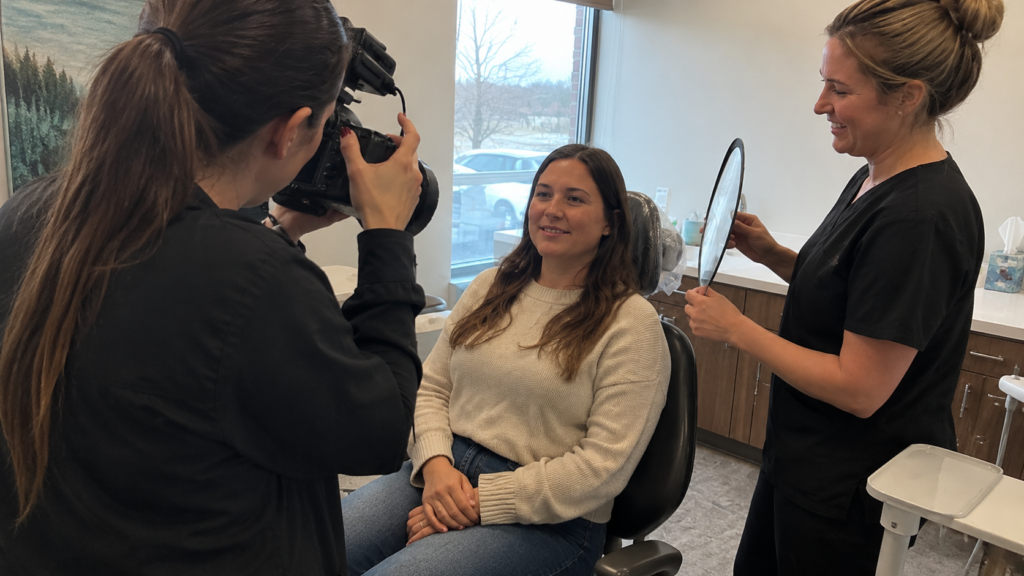
Your team may take photographs from several angles. Depending on your needs, images might show your front teeth, side views, bite relationship, or other areas relevant to treatment planning.
Some photos may be taken while you smile. Others may require mirrors or retractors so the team can capture areas that are harder to see in a standard photograph. Your team can explain what they are doing as they work.
Not every patient receives exactly the same number or type of photographs. The images selected depend on the individual evaluation.
At Bass & Watson Family Dental, a dedicated photo studio is used for high-resolution new-patient, cosmetic, and before-and-after photography.
How Do Dental Photos Complement Your Examination?
Dental photographs can be part of a comprehensive evaluation, but they are not a substitute for an examination.
Your dentist may combine several sources of information, including your health history, clinical findings, photographs, and diagnostic imaging when appropriate. Each provides a different view of your oral health.
Photographs are especially useful for documenting visible features of the teeth, gums, and smile. They also give the dental team something concrete to review with you after the initial examination.
How Are Dental Photos Different From X-Rays?
Dental photographs and X-rays provide different kinds of information.
Photographs primarily show visible features of the teeth, gums, and smile. Dental X-rays can provide information about structures that cannot be fully evaluated simply by looking at the outside of the teeth.
Because they answer different questions, photographs and X-rays can complement one another rather than replace one another. Your dentist determines which tools are appropriate based on your individual needs.
How Are Dental Photos Different From Intraoral Cameras?
Bass & Watson Family Dental also uses intraoral cameras as part of its digital diagnostic and patient-education tools.
An intraoral camera is designed to capture close-up views of specific areas inside the mouth. Professional dental photography can provide a broader visual record of the teeth and smile.
For example, an intraoral camera may help your dentist show you a particular tooth in greater detail. Professional photography may be useful for documenting the overall appearance of your smile or supporting cosmetic and restorative planning.
Both can support communication, but they are not interchangeable.
Why Are Photos Helpful for Patient Education?
Sometimes a dental finding is easier to understand when you can see it yourself.
You may hear your dentist describe a chipped edge, an existing restoration, tooth wear, or another visible feature and still have difficulty picturing it. A photograph gives you a reference point.
Instead of relying entirely on a verbal explanation, your dental team may be able to show you the image and point to the area being discussed. This can make it easier to ask questions and take part in conversations about your care.
That approach fits Bass & Watson Family Dental’s emphasis on patient education and helping patients feel informed and involved in treatment decisions.
How Can Photography Support Cosmetic Treatment Planning?
Professional photography can be especially useful when the appearance of the smile is part of the treatment discussion.
At Bass & Watson Family Dental, photography is used to support personalized cosmetic dentistry and restorative planning.
Depending on the situation, photographs may help document:
- Tooth proportions
- Tooth edges
- Smile characteristics
- Existing restorations
- Tooth color
- Overall appearance
These images can give the dental team a consistent visual reference while discussing your goals and evaluating possible options.
A photograph cannot determine the right treatment on its own. Cosmetic recommendations still depend on a comprehensive evaluation, your oral health, the condition of your teeth, and your individual goals.
How Can Photography Support Restorative Treatment Planning?
Photography can also support conversations about restorative care.
If you have a damaged tooth, an existing restoration, or another visible concern, a photograph may help document the area and provide a useful reference during treatment discussions.
Your dentist may use photographs with the clinical examination and other diagnostic information to explain why a restoration or another treatment option is being considered.
Photos are one part of the planning process rather than the entire diagnosis.
Can Photos Provide a Visual Reference Over Time?
Dental photographs can provide a visual reference that may be useful when comparing the appearance of your teeth or smile at different points in care.
For example, images may document the starting appearance before selected cosmetic or restorative treatment and provide a reference for later comparison.
However, photos should not be treated as the sole measure of treatment success. Lighting, camera angle, positioning, and other factors can influence how an image looks. They are most useful when considered alongside dental records and clinical assessments.
Will Dental Photos Feel Uncomfortable?
Professional dental photography is intended to document the teeth and smile rather than perform treatment.
Your dental team may ask you to smile, open your mouth, or position your head in certain ways. Some photographs may use mirrors or retractors depending on what needs to be shown.
If you have questions or concerns, tell the team. They can explain the purpose of the images and what to expect before proceeding.
What If I Am Embarrassed About My Teeth?
Feeling self-conscious about dental photography is understandable, especially if you have delayed care or feel embarrassed about the appearance of your teeth.
The purpose of the photos is not to judge you. They are used to document what the dental team sees, support communication, and help with treatment planning when appropriate.
Bass & Watson Family Dental specifically emphasizes judgment-free care and reassures patients who have delayed dental visits or feel embarrassed about their teeth that they will be listened to and treated respectfully.
Dental photographs are part of the care process, not a test you need to pass.
Do I Need Dental Photos at Every Appointment?
Not necessarily.
Professional photography may be especially useful during a first dental visit, selected cosmetic consultations, restorative planning, or when the dental team wants a visual reference over time.
Routine visits may have different documentation needs. The decision to take photographs depends on the purpose of the appointment and the information your dentist needs.
A More Personal Way to Understand Your Smile
Dental photography may seem like an extra step during a first visit, but it can serve several practical purposes.
Photographs can document visible findings, help you understand what your dentist is discussing, support cosmetic and restorative treatment planning, and provide a visual reference that can be reviewed later.
Most importantly, photos are only one part of the evaluation. They do not replace your dentist’s clinical judgment, examination, or diagnostic imaging when imaging is appropriate.
At Bass & Watson Family Dental, professional dental photography and other digital tools are intended to support personal communication rather than replace it. The practice combines technology with a welcoming, judgment-free approach designed to help patients understand their care and feel involved in treatment decisions.
If you are preparing for your first appointment and have questions about what to expect, contact Bass & Watson Family Dental to learn more about your visit.
