

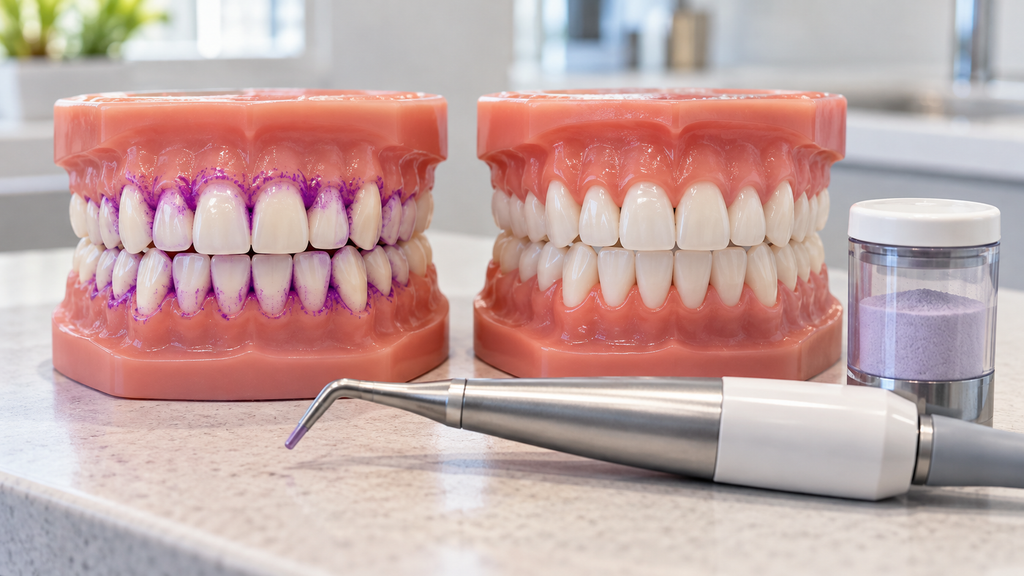
Guided Biofilm Therapy (GBT) changes how a dental team organizes professional cleaning around identifying and removing biofilm. A temporary coloring agent makes plaque easier to see, helping guide cleaning and show you where your home-care routine may need attention.
GBT combines that visual approach with air polishing, removal of remaining hardened deposits when needed, and an individualized follow-up plan. It does not mean that conventional instruments disappear or that every patient receives the same treatment.
At Bass & Watson Family Dental in Apex, NC, we use Guided Biofilm Therapy as part of our preventive care. We want you to understand what happens during your visit and feel comfortable sharing questions or concerns.
What Is Dental Biofilm?
Dental biofilm is a community of microorganisms attached to a surface within a protective matrix. Dental plaque is a familiar example.
Plaque forms continually, including around the gumline, between teeth, and near dental restorations. When it is not adequately controlled, it can contribute to tooth decay and gum inflammation.
Biofilm and tartar are different. Tartar, also called calculus, is hardened plaque that usually needs professional instruments for removal. An air-polishing step that removes soft biofilm does not automatically remove every hardened deposit.
Surface stains are another consideration. A tooth can look stained without that appearance showing exactly how much plaque or tartar is present. Likewise, teeth that look clean may still have deposits in difficult-to-see areas.
That is why assessment comes before choosing cleaning methods. Your dental team evaluates the condition of your teeth and gums rather than judging treatment needs by appearance alone.
What Makes GBT a Defined Cleaning Approach?
GBT is an eight-step protocol developed by EMS. It brings assessment, biofilm disclosure, patient education, cleaning, and follow-up into a structured sequence.
A defining feature is disclosure: applying a temporary coloring agent to make biofilm visible. This provides a guide for the clinician and a useful visual aid for discussing home care.
Seeing plaque highlighted is information, not a judgment about your effort. Crowding, dental work, limited dexterity, and other factors can make some areas difficult to clean. The goal is to identify practical adjustments.
The protocol also separates soft biofilm removal from the removal of remaining calculus. Different deposits can require different tools, even during the same appointment.
What Are the Eight Steps?
The outline below summarizes the EMS framework in patient-friendly language. Treatment areas and instrument use depend on your examination and clinical needs.
| Step | What it involves |
| 1. Assessment and infection control | Review oral health, relevant history, and treatment needs before cleaning. |
| 2. Disclose | Use a coloring agent to make biofilm visible. |
| 3. Motivate | Discuss the findings and demonstrate suitable home-care techniques. |
| 4. AIRFLOW® | Use air, water, and suitable powder to remove biofilm and stains in appropriate areas. |
| 5. PERIOFLOW® | Address biofilm in deeper areas below the gumline when indicated. |
| 6. PIEZON® | Use ultrasonic instrumentation to remove remaining calculus where needed. |
| 7. Check | Evaluate the result and address remaining deposits as necessary. |
| 8. Recall | Recommend the next visit according to individual risk and care needs. |
These steps describe the protocol’s framework rather than a promise that every patient needs every treatment component.
For example, deeper subgingival cleaning is selected according to periodontal findings, rather than performed simply because the protocol includes that capability.
How Does This Compare With a Conventional Cleaning?
Conventional cleanings also remove plaque and calculus, assess oral health, and provide patient education. They may involve hand instruments, ultrasonic instruments, polishing, and other techniques selected for the patient.
GBT organizes care around disclosed biofilm and a defined sequence of cleaning methods. The difference is not that conventional dentistry ignores plaque or focuses only on making teeth look polished.
Disclosing agents and air polishing can also be used outside a complete GBT protocol. A single air-polishing treatment should therefore not automatically be described as Guided Biofilm Therapy.
The amount of calculus matters. Someone with mostly soft deposits may need relatively little calculus removal, while another patient may require more instrumentation. Using an ultrasonic instrument during GBT does not mean the approach has failed.
The useful question is whether the cleaning plan addresses your findings. Our cleanings and exams help us evaluate those needs and explain the recommended care.
What Might You Notice During the Appointment?
The coloring agent can make plaque more noticeable than it was before the appointment. The hygienist can use those areas to explain where brushing or interdental cleaning could be adjusted.
During air polishing, you may notice water, air, a powder sensation, and suction. If calculus removal is needed, you may also feel vibration or pressure from the instruments used.
We use warm water with our GBT system. Some patients may prefer that experience, but comfort still depends on tooth sensitivity, gum condition, the area being treated, and personal preferences.
Tell us about previous uncomfortable cleanings, sensitive roots, tender gums, or difficulty tolerating water and suction. We can discuss what to expect and how to signal if you need a pause.
GBT should not be understood as a promise of pain-free treatment. Clear communication helps the team respond to your experience throughout the visit.
Does GBT Replace Treatment for Gum Disease?
The diagnosis still determines the type of care you need. GBT can be used within preventive, periodontal treatment, or maintenance care, but the equipment does not replace a periodontal diagnosis or an appropriate treatment plan.
A routine preventive cleaning has a different purpose from active treatment for periodontitis. If your examination identifies disease affecting the tissues supporting your teeth, the team will explain the findings and recommended next steps.
Air polishing alone should not be presented as a substitute for all indicated treatment. Additional instrumentation, reassessment, or other care may be necessary.
Likewise, having a GBT cleaning does not remove the need for future examinations. Gum measurements, symptoms, treatment history, and risk factors continue to guide recommendations.
What Should You Tell the Team Before Cleaning?
Share changes in your health, medications, allergies, tooth sensitivity, or previous reactions to dental products. Mention dental work or appliances and any areas that are difficult to clean.
The clinician selects powders, instruments, and treatment areas according to the situation and product instructions. You do not need to choose a powder or device yourself.
If you are unsure why a particular method is recommended, ask:
- What did you find during my examination?
- Which parts of the GBT approach are appropriate for me?
- Will additional calculus removal or periodontal treatment be needed?
- What should I expect if my teeth are sensitive?
These questions help connect the technology with your actual care needs.
What Happens After the Cleaning?
Before you leave, make sure you understand the home-care recommendations and follow-up plan. If a specific area repeatedly collects plaque, ask the hygienist to demonstrate how to reach it.
Brush twice daily with fluoride toothpaste and clean between your teeth each day using suitable tools. Biofilm reforms, so professional cleaning complements rather than replaces daily care.
The interval between visits depends on your oral health and risks. Patients with previous periodontal treatment or other ongoing concerns may need a different schedule from someone receiving routine preventive care.
If sensitivity develops, persists, or worsens after the visit, contact the practice for advice. Do not assume every symptom is simply an expected effect of cleaning.
A useful outcome of the appointment is knowing what to focus on at home and when the team wants to reassess your oral health.
Explore Your Cleaning Options With Bass & Watson Family Dental
GBT offers a structured way to make biofilm visible, guide its removal, and connect professional care with your daily routine. Its role depends on your examination, the deposits present, and your overall treatment needs.
At Bass & Watson Family Dental, we combine preventive care with clear explanations and a welcoming approach. If cleanings have felt uncomfortable or you are curious about GBT, we encourage you to share those concerns.
Schedule a Cleaning and Exam at our Apex practice to discuss your oral health and the care appropriate for you.
